
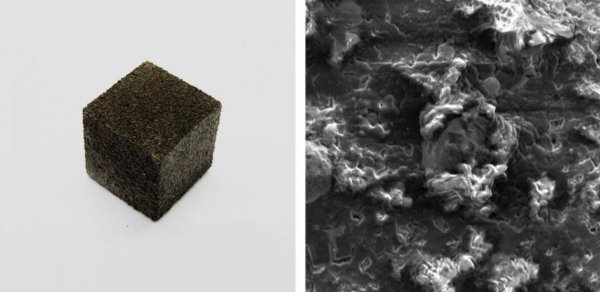
A collaborative team of nanotechnologists from Rice University in Houston and Tianjin University in China has developed a method to fabricate centimeter-scale objects made of atomically thin graphene using common sugar and nickel. The process, which operates at room temperature, employs a variant of 3D printing known as laser sintering, allowing precise control over pore structure and yielding materials that are 99 percent air—preserving graphene's exceptional lightness.
Graphene, a single layer of carbon atoms arranged in a hexagonal lattice, has long been hailed for its remarkable properties: it is roughly 200 times stronger than steel and exhibits high electrical conductivity. These attributes have made it a candidate for applications ranging from faster data transmission to quantum computing, seawater desalination, and bionic implants. Yet, despite its promise, the material's adoption has been hindered by the lack of scalable production methods.
The new technique, described in a paper published in the journal ACS Nano, diverges from conventional 3D printing, which extrudes melted plastic through a nozzle. Instead, the team used a laser to sinter—or fuse—powdered materials. In their experiments, they combined sugar and nickel powder, which, upon cooling, formed graphene. The researchers then optimized laser power and exposure time to refine the process.
Co-lead author Junwei Sha, a postdoctoral researcher at Tianjin University, noted in a Rice University press release that the method is customizable. By altering the precursor powders, the team expects to produce specialized graphene foams, including rebar graphene—graphene reinforced with carbon nanotubes—as well as nitrogen- and sulfur-doped variants. This flexibility could expand the material's utility across industries.
Scaling Up Graphene Production
The ability to produce graphene foam at scale has been a significant hurdle. Rice chemist James Tour, a co-author of the study, emphasized in the same release that the team demonstrated a route to create 3D graphene foams from non-graphene starting materials, and the approach is amenable to additive manufacturing applications. This scalability is crucial for moving graphene from laboratory curiosities to real-world products.
Other research groups have also pursued alternative mass-production strategies. For instance, the University of Kansas explored detonating carbon-containing compounds to generate graphene, while Brookhaven National Laboratory investigated a method to grow graphene on industrial-grade glass. These efforts highlight a broader scientific push to overcome the manufacturing bottleneck.
The Rice-Tianjin collaboration adds a distinct option: a low-cost, room-temperature process that leverages abundant materials. While the method is still in its early stages, the ability to control shape at the pore level and achieve high porosity suggests potential for lightweight structural components, energy storage devices, and filtration systems. The researchers' findings offer a practical step toward unlocking graphene's widespread use, though further development and scaling trials are needed before commercial deployment.
Comments 0