
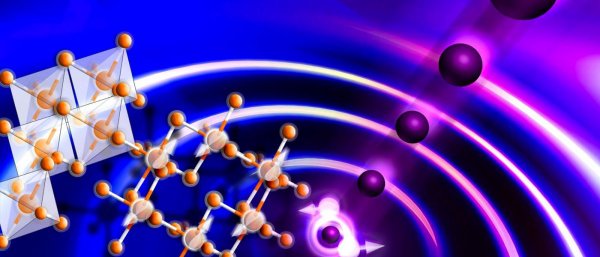
An international collaboration of physicists has reported the first direct observation of a quantum spin liquid in a two-dimensional material, a state of matter where electrons appear to break apart—a phenomenon long theorized but never before seen in real systems. The findings, based on neutron scattering experiments on crystals of ruthenium trichloride (RuCl3), confirm a prediction made more than four decades ago and open new avenues for quantum computing.
In conventional magnets, electrons act like tiny bar magnets, with their magnetic poles aligned in a uniform direction. But in a quantum spin liquid, that alignment never occurs. Instead, quantum fluctuations create a kind of "entangled soup," where the magnetic moments remain in constant, disordered motion. This exotic behavior was first proposed in the 1970s, but until now, no material had been shown to exhibit its most striking consequence: the fractionalization of electrons into quasiparticles known as Majorana fermions.
The research team, whose members span multiple institutions, used neutron scattering to probe the magnetic properties of RuCl3. By bombarding the crystals with neutrons and analyzing the ripple patterns on a detector screen, they sought evidence of the entangled state. A conventional magnet would produce sharp, distinct spots, but the pattern from a quantum spin liquid was expected to be diffuse and continuous—a signature of the fractionalized particles.
The observed patterns matched the theoretical predictions, providing the first direct evidence of electron splitting in a two-dimensional material. "It's an important step for our understanding of quantum matter," said Alexei Kovrizhin, one of the researchers, in a statement. "It's fun to have another new quantum state that we've never seen before – it presents us with new possibilities to try new things."
Implications for Quantum Computing
The Majorana fermions that emerge from this splitting are of particular interest because they are considered promising building blocks for quantum computers. Unlike conventional bits, which are either 0 or 1, quantum bits (qubits) can exist in superpositions, potentially enabling calculations far beyond the reach of classical machines. The stability of Majorana-based qubits could make them less prone to errors, a key hurdle in quantum computing.
While the current observation is a fundamental physics milestone, practical applications remain distant. The researchers emphasize that the discovery deepens our understanding of quantum matter, but they do not speculate on timelines for technological deployment. The work also raises questions about how such states might be manipulated or stabilized in other materials.
The study, which has been published in a peer-reviewed journal, adds a new chapter to the study of topological states of matter, a field that has already yielded insights into superconductivity and other exotic phenomena. As Kovrizhin noted, the discovery "presents us with new possibilities to try new things," a sentiment echoed by physicists who see this as a springboard for future experiments.
Comments 0