
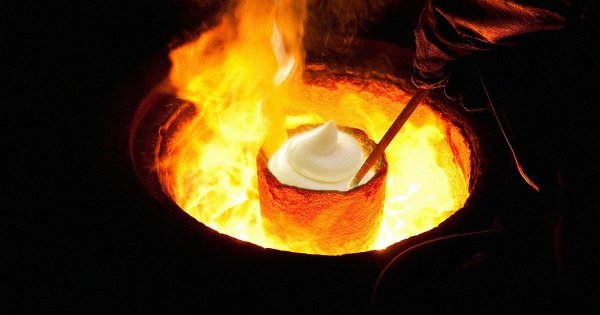
In the quest to harness nuclear fusion, researchers at Lehigh University have turned to an unlikely ally: mayonnaise. The common condiment is helping scientists understand a destructive instability that can cause fusion fuel pellets to burst before ignition, a problem that has long hindered inertial confinement experiments.
Arindam Banerjee, an associate professor of mechanical engineering and mechanics at Lehigh, leads a team that studies how materials behave under extreme forces. Their latest work, published in the journal Physical Review E, uses mayonnaise to mimic the behavior of molten metal in the split-second before a fusion capsule fails.
In inertial confinement fusion, tiny pea-sized pellets containing fusion fuel are placed in a chamber and blasted with powerful lasers. The goal is to compress the fuel to temperatures of millions of Kelvin, triggering a fusion reaction. But the process, which unfolds in nanoseconds, often ends prematurely: the pellet's outer layer and the gas inside mix violently, causing an explosion before fusion can occur.
This mixing is driven by what physicists call Rayleigh-Taylor instability, which arises when materials of different densities are accelerated together. Banerjee compares it to a balloon being squeezed: the air inside pushes against the rubber, and eventually the balloon bursts. In a fusion capsule, the same dynamic occurs between the molten metal shell and the compressed gas.
To study this phenomenon in a controlled setting, Banerjee and his collaborators sought a stand-in for the molten metal. They found that mayonnaise, at room temperature, exhibits similar material properties and dynamics to the metal under extreme heat. So they poured Hellman's Real Mayonnaise into a Plexiglass container and subjected it to conditions that replicate the fusion environment.
Using a high-speed camera and an image-processing algorithm, the team tracked how the mayonnaise deformed and mixed under stress. The results, they say, provide new insight into the threshold at which elastic-plastic materials become unstable—knowledge that could refine computer models used to design fusion experiments.
Why a Condiment?
Mayonnaise is an elastic-plastic material, meaning it can stretch and deform like a solid until it reaches a breaking point, then flows like a liquid. This dual behavior mirrors the molten metal in a fusion capsule, which also transitions from a solid-like state to a fluid state under extreme pressure and temperature.
Banerjee, who has been experimenting with mayonnaise since at least 2015, says the approach offers a practical way to study complex hydrodynamics without the need for high-energy laser facilities. The experiments are relatively simple and inexpensive, yet they capture the essential physics of the instability.
The findings have implications beyond fusion. Better understanding of Rayleigh-Taylor instability could aid research in geophysics, astrophysics, and industrial processes such as explosive welding, where similar mixing phenomena occur. For fusion, the work could help engineers design capsules that are more resistant to premature failure, bringing inertial confinement closer to a viable energy source.
The study was published in Physical Review E, a peer-reviewed journal of the American Physical Society. The research was supported by Lehigh University, though specific funding sources were not disclosed in the original announcement.
Comments 0