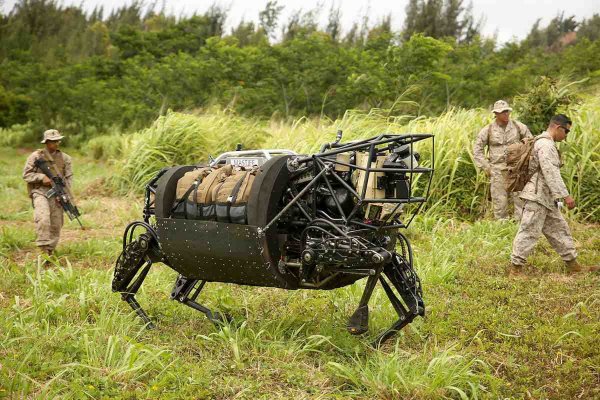
The U.S. Marine Corps has quietly shelved plans for a four-legged robotic pack mule, the LS3, after years of testing revealed that the machine's loud gas engine could betray troop locations on the battlefield. The decision, confirmed by service officials, brings an end to a project that once promised to lighten the load for infantry units by carrying up to 180 kilograms (nearly 400 pounds) of gear across rugged terrain.
Developed under the Defense Advanced Research Projects Agency (DARPA) with a $32 million (£21 million) contract awarded to Boston Dynamics in 2008, the LS3 — formally the Legged Squad Support System — was designed to follow soldiers autonomously, responding to visual and verbal cues rather than requiring a remote controller. In tests, it demonstrated the ability to complete a 20-mile mission over rough ground on a single 24-hour run, a capability that drew interest from military planners.
But the same power plant that gave the robot endurance also produced a persistent mechanical roar. Marines who field-tested the machine in realistic scenarios quickly flagged the noise as a critical vulnerability, arguing that the sound could give away their position to enemy forces. Despite repeated attempts to muffle the engine or alter the design, engineers could not bring the acoustic signature down to acceptable levels.
Why the Noise Mattered
Kyle Olson, a spokesperson for the Marine Corps Warfighting Lab, told Military.com that troops saw the robot's limitations clearly. "As Marines were using it, there was the challenge of seeing the potential possibility because of the limitations of the robot itself," he said. "They took it as it was: A loud robot that's going to give away their position." Olson added that the program was always intended to be a learning exercise, noting, "We tend to make things that are fanciful and strange. Learning from it was a big part, and we're still learning."
The LS3 was part of a broader military push to integrate thousands of robots into Army forces by 2030, and its cancellation represents a notable setback. However, officials stress that the data collected from the LS3's development and field trials will inform future robotic designs, particularly around noise reduction and autonomous navigation.
A Lighter Successor, but Not Ready
In an attempt to address the noise issue, Boston Dynamics also produced a smaller robot called Spot. But Spot's lighter frame meant it could carry only about 18 kilograms (40 pounds), and it lacked the autonomy needed for independent operation. James Pineiro, head of the Ground Combat Element branch at the Warfighting Lab, described Spot's current role as "more of a ground reconnaissance asset," but he acknowledged its limitations: "The problem is, Spot in its current configuration doesn't have the autonomy to do that. It has the ability to walk in its environment, but it's completely controller-driven."
With the LS3 now retired, the Marine Corps is left with a gap in its logistical capabilities, but the lessons learned are expected to shape the next generation of unmanned ground vehicles. The challenge, as one official put it, is to build a machine that can carry heavy loads without making its presence known.
Comments 0