
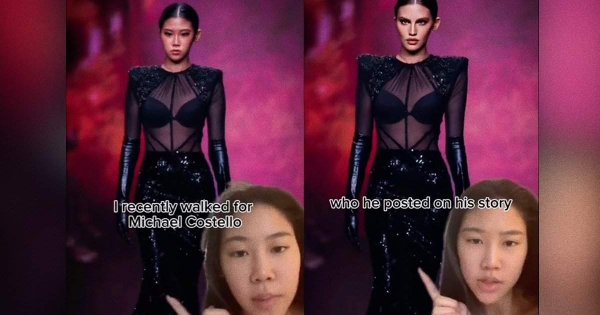
Taiwanese-American model Shereen Wu has publicly accused fashion designer Michael Costello of sharing an AI-altered photo of her that changed her facial features to appear white, an incident that has ignited a broader conversation about racial bias in image-editing technology and the treatment of independent models.
In a TikTok video that has since gone viral, Wu demonstrated how a photo of her walking the runway for Costello had been processed through a filter that not only added heavy, airbrushed makeup but also altered her ethnicity. The designer initially reposted the image, which appeared to be generated by an app similar to FaceApp, before deleting it and claiming it was 'fan art' sent to him by someone else.
Wu shared a screenshot of Costello's response, in which he said there was 'nothing [he] could do' about the poorly edited image, told her he had cast her because he 'liked' her, and notably did not apologize. In her video, Wu said, 'I understand as a model, I am replaceable. But I don't get paid to do these shows, [and] while I don't get paid, there's a tacit understanding that I'm doing this for exposure and for photographs.'
Speaking to The Guardian, Wu explained that the edited photo deprived her of even that exposure. 'I didn't get exposure, because this is an edited photo,' she said. 'By cutting off my head, neither did the makeup artist, hairdresser or photographer. That's what peeves me so much.' As an independent model without agency representation, such photos are her primary means of getting her name and face out there.
Costello, who in 2021 faced legal threats from supermodel Chrissy Teigen over allegedly doctored screenshots, later posted and deleted a statement claiming he was 'moving forward with legal proceedings' against Wu for what he called false allegations in her TikTok. Wu has since contacted an advocacy group and been referred to a lawyer, according to The Guardian.
Broader Pattern of AI Bias
The incident is not isolated. Over the summer, MIT graduate student Rona Wang told Insider that she used the AI image creator Playground AI to make a LinkedIn headshot look more 'professional.' The app returned a nearly identical photo, except her features had been changed to make her look white. Wang said her initial reaction was 'amusement,' but she expressed concern: 'I definitely think it's a problem. I hope people who are making software are aware of these biases and thinking about ways to mitigate them.'
Wu, however, was less forgiving. 'I hope people can understand how hurtful it is to have your work stolen from you,' she told The Guardian. 'It's very dehumanizing.'
As AI becomes increasingly embedded in daily life—from image generators to hiring algorithms—efforts to reduce human bias in these systems have lagged behind the technology's rapid advancement. The incidents involving Wu and Wang underscore the urgent need for developers to address racial and ethnic biases in AI, lest the machines perpetuate the very prejudices they are meant to overcome.
Comments 0